Introduction
MultiLipi's Role in Global Localization
At MultiLipi, we fuse AI powered localization with CMS and e commerce systems to deliver seamless multilingual experiences. Our approach emphasizes fast, editable translations that preserve tone and brand voice across languages. Alphabet-backed initiatives and broader Alphabet AI ventures inform push toward privacy-preserving, enterprise-ready localization at scale.
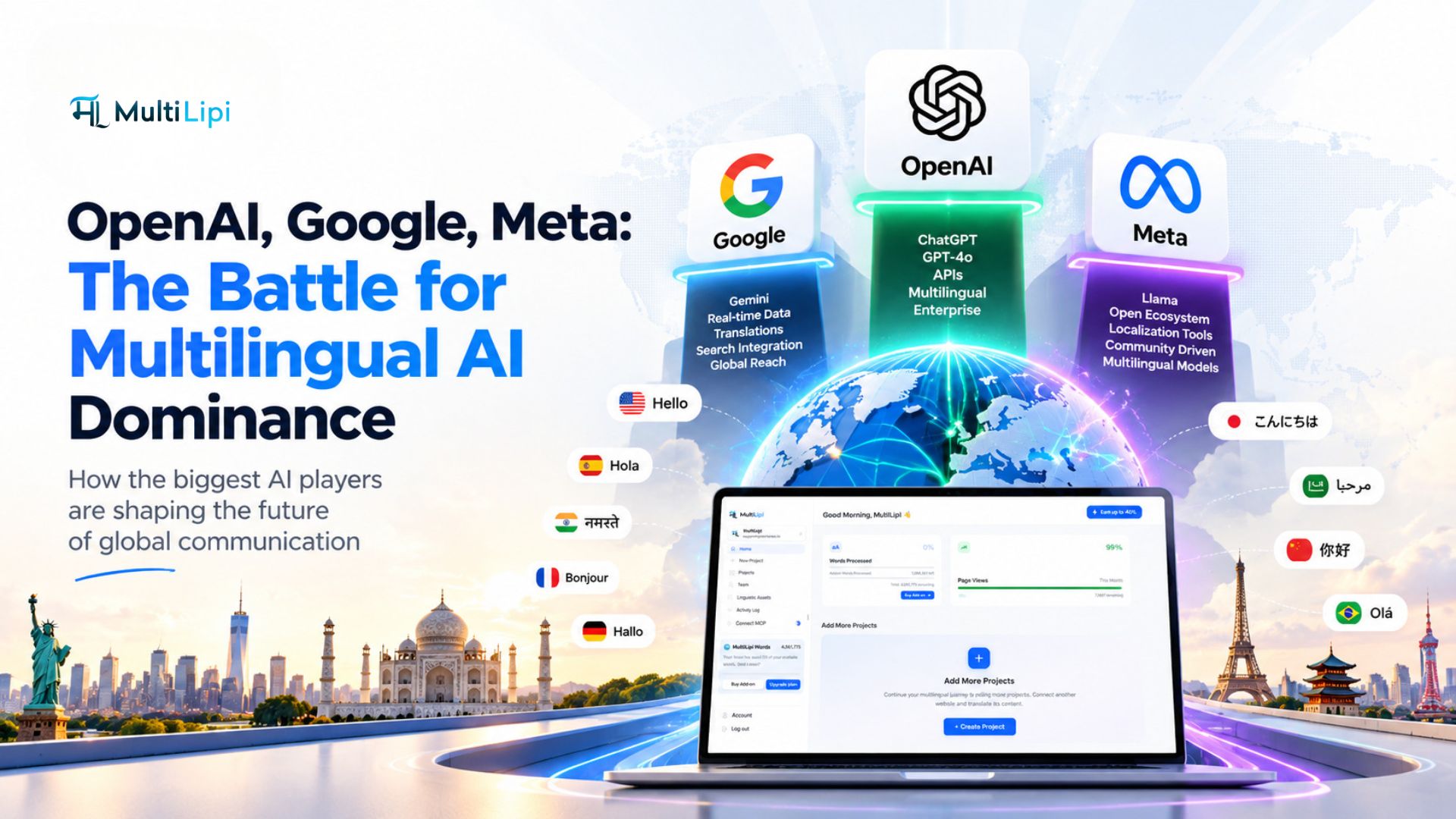
The multilingual AI race among OpenAI, Google, and Meta centers on expanding language coverage while prioritizing privacy, governance, and scalable localization for enterprises (e.g., Hindi, French, Japanese, Arabic, Spanish).
Key players offer complementary strengths: OpenAI for broad multilingual tasks and APIs; Gemini for real-time data-enabled translations; Llama/Open ecosystem for open, community-driven localization tooling.
Enterprises should pursue end-to-end localization pipelines, strong data governance, and multilingual SEO to accelerate global product launches and maintain brand voice across markets.
MultiLipi positions itself as a central hub for scalable localization, enabling integrated CMS/e-commerce workflows, region-specific privacy controls, and open standards to foster ecosystem collaboration.
Broad multilingual tasks and API-driven workflows for flexible enterprise use.
Gemini-led automation with real-time data access and connected productivity ecosystems.
🧠 The enterprise moat sits between the model and the market
- Language coverage matters, but workflows, governance, privacy controls, and localization quality determine whether that capability works at enterprise scale.
- A strong operating layer connects model output to CMS, commerce, metadata, review, and regional publishing without losing brand intent.
- That makes localization infrastructure a strategic layer rather than a simple translation step.
- One line code integration for quick setup
- Editable translations to maintain accuracy over time
- Multilingual SEO optimizations to support global discovery
Consider a mid sized retailer launching in France, India, and Brazil. A single CMS fed by our pipeline yields translated product descriptions, metadata, and help content that stay aligned with the brand. You can monitor quality with post publish checks and quick corrections within the editor.
We view the multilingual AI race as an opportunity to connect audiences at scale while upholding privacy and data control. Our platform aligns with enterprise needs for reliability, speed, and global reach, supporting organizations as they navigate open and proprietary AI ecosystems. ChatGPT powers many of these multilingual workflows, delivering contextual responses and translations at scale across languages. The Gemini integration with Google Workspace and Android is central to Google's strategy, facilitating AI-driven automation that enhances real-time data-enabled translations and streamlines workflow efficiency. Didier Bonnet is frequently cited in industry analyses for his insights on enterprise AI governance and global localization strategy, helping executives align multilingual initiatives with business outcomes.
Key Players and Their Multilingual Strategies
Meta's Llama and Open Ecosystem for Developers
Businesses experiment with the process of adapting a product, content, or document to a specific locale or market through the Llama open-source strategy, which incorporates multimodal capabilities alongside Gemini, sharing models and tooling within the ecosystem to leverage its multilingual attributes. This openness accelerates prototyping for multilingual content and chat experiences, while robust governance tools help safeguard privacy, ensuring a flexible and efficient workflow across various formats.
Open ecosystem features include model sharing, tooling for fine-tuning, and collaboration across partners. The aim is to enable rapid localization of apps and websites without locking enterprises into a single vendor.
- Open model accessibility encourages experimentation
- Developer tooling for localization pipelines
- Community-driven improvements across languages
Language Coverage and Accessibility Initiatives
🌍 Coverage only becomes advantage when quality scales with it
- Underrepresented languages need durable datasets, evaluation standards, and community participation—not one-time translation coverage.
- Enterprises also need privacy, licensing, and maintenance policies that work across scripts and regions.
- The practical objective is consistent multilingual usefulness, not a headline language count.
Coalitions and Partnerships for Underrepresented Languages
You are witnessing industry coalitions formed to broaden linguistic reach beyond the big five languages. These collaborations focus on building data sets, establishing evaluation benchmarks, and enabling open governance so smaller languages gain model parity. The result is cross-stakeholder input that shapes inclusive AI capabilities you can rely on.
Key dynamics to watch include joint funding for language resources, shared multilingual evaluation standards, and privacy protections that span languages. Partnerships often center on multilingual governance and sustained support for low-resource languages through community-driven datasets and translation tasks.
- Joint language resource development programs
- Shared multilingual evaluation benchmarks
- Privacy-first data handling commitments
Open Models and Language Inclusivity
Open models are advancing with mechanisms that emphasize inclusive language coverage while upholding safety controls. Transparency in training data and evaluation results helps developers assess suitability for regional applications, from education to customer service.
Expect a mix of transparent weights, community-contributed datasets, and region-specific fine-tuning options that stay aligned with local needs. This approach encourages local innovation without sacrificing global interoperability.
Open ecosystem trade-offs
"开放模型与语言包容性并行推进,透明的评估和数据来源是实现全球可持续进步的关键。", 行业分析师
Enterprise Integration and Localization at Scale
AI Driven Localization for CMS and E-commerce
Large organizations rely on AI to automate content localization across CMS platforms and storefronts. The goal is to deliver culturally aware, linguistically precise assets without slowing publishing cycles. Expect tight integration with content workflows, brand panels, and product catalogs.
Practical example: a global retailer adding Spanish, French, Hindi, and Japanese product descriptions synced to catalog feeds. A localization layer updates metadata, alt text, and currency formats in real time, while editors review only edge cases.
When implementing, start with a shared multilingual glossary and entity recognition to preserve brand voice across languages. Track glossary updates in a centralized dashboard to prevent drift across regions.
- Unified translation memory across CMS and product feeds
- Terminology management aligned with brand guidelines
- Automated QA checks for linguistic and contextual accuracy
Multilingual SEO and Fast Translation Pipelines
Multilingual SEO requires dynamic rendering of metadata, structured content, and locale aware hreflang signals. AI driven pipelines speed up metadata generation, enabling sites to rank in local search results without manual overhauls. This yields faster indexing and higher click through rates in diverse markets.
Concrete steps: map top landing pages for each target market, generate locale specific titles and descriptions, and run regular crawl tests to catch canonicalization issues. For example, a campaign in Arabic markets may require right to left adjustments and locale aware date formats.
Fast translation pipelines use streaming translation, post editing, and automated adaptation of content blocks for regional preferences. This supports launches in markets with high linguistic variety, from Arabic speaking regions to Latin American locales.
- Locale specific metadata generation at scale
- Automated image and video localization hooks
- Continuous performance monitoring across languages
Enterprise localization operating signals
Competitive Tactics and Ecosystem Lock-In
Data Ecosystems, Real-Time Access, and Workflow Automation
You rely on data ecosystems that feed multilingual capabilities, allowing for real-time data access essential for AI-powered enterprise decision-making. This access to fresh information enhances accuracy across languages and domains while automation ties translation, validation, and publishing into a seamless workflow loop.
- Unified data streams across search, productivity, and messaging products
- Real-time retrieval for up-to-date responses in multiple languages
- Automated routing of content through translation, QA, and deployment
Ecosystem lock-in pressure points
Developer Tools, Open Models, and Ecosystem Momentum
Developer tooling accelerates adoption and localization at scale. Open models and shared standards unlock community contributions. Momentum comes from broad tooling adoption, comprehensive documentation, and predictable update cadences.
- SDKs, eval kits, and multilingual benchmarks for faster prototyping
- Community models and region-specific fine-tuning options
- Consistent release trains that reduce integration friction
Developer ecosystem leverage
Impact on Global Markets and Jobs
Economic Impact and Skill Shifts
The push for multilingual AI is reshaping demand across regions. You can expect growing opportunities in data governance, localization engineering, and language specific model evaluation. When companies scale language capabilities, they unlock faster entry into new markets, fueling regional growth and creating roles in AI operations, content localization, and multilingual customer support.
Across industries, organizations use multilingual models to cut localization costs and shorten time to value for global product launches. This drives demand for regional analytics, cross cultural product design, and multilingual user experience research.
For example, a consumer fintech firm expanding into Southeast Asia hires a localization engineer to adapt risk model labels, handles customer support in Malay and Thai, and sets up language specific guardrails. A SaaS vendor tests model performance across French and Portuguese locales to ensure compliant wording in receipts and help centers. These practical steps reduce go to market risk and improve adoption rates.
Regulation, Trust, and Responsible AI in Multilingual Contexts
Regulators are leaning toward transparent data handling and bias mitigation across languages. Multilingual AI systems must show governance that protects user privacy, prevents harmful outputs, and upholds ethical standards in every locale.
Trust hinges on explainability and accountability in multilingual deployments. Enterprises invest in audit trails, language specific safety checks, and clear user consent mechanisms to support responsible AI use in diverse markets.
Global-market impact map
Future Scenarios and Strategic Considerations
What Dominance Looks Like for Multilingual AI
Dominance goes beyond translating words. It requires deep cross-language understanding, robust privacy protections, and scalable governance across regions. Leaders will harmonize meaning across cultures and domains, delivering real-time multilingual comprehension in apps, search, and productivity tools.
Language capabilities will become a baseline for enterprise automation and consumer experiences alike.
- Unified multilingual pipelines across core products and partner ecosystems
- Robust privacy controls that scale with data breadth and regional rules
- Transparent safety and bias controls across all languages
What multilingual AI dominance requires
Strategic Implications for Localization Platforms like MultiLipi
Localization platforms must move from a translation layer to an integrated localization spine that supports the growing multilingual AI dominance in enterprise ecosystems. The focus shifts to workflows, data governance, and multilingual quality assurance that scales with product velocity in this new landscape. Open standards and collaborations will shape how ecosystems align around this multilingual AI innovation. Use MultiLipi as the central hub for content localization, product copy, and user support across markets.
- Modular localization pipelines tied to content creation and publishing
- Interoperability with major AI models and multilingual benchmarks
- Clear governance for data usage, model updates, and regional customization
Localization platform action matrix
FAQ
Here are concise, forward‑looking answers to common questions about multilingual AI across the major players. Each entry highlights current capabilities and practical implications for developers, enterprises, and multilingual users.
Which companies lead in multilingual AI APIs?
OpenAI, Google, and Meta provide multilingual capabilities through their APIs and developer ecosystems. Each platform emphasizes different strengths: OpenAI GPT and its large language model family for flexible text and code tasks, Google Gemini for enterprise automation and real‑time data processing, and Meta with Llama models that balance openness and practical multilingual understanding. Expect a mix of real‑time data access, robust integration options, and broad ecosystem support across these players.
How do privacy and data governance affect multilingual deployments?
Privacy controls and regional data governance shape model access, data retention, and safety checks. Enterprises should map data flows to local rules, implement language‑specific consent, and maintain audit trails. A strong governance layer improves compliance while enabling multilingual use cases across apps, search, and workflows.
What benchmarks measure cross‑language quality?
Benchmarks assess translation fidelity, semantic alignment, and real‑time understanding across languages. They also test domain‑specific accuracy in areas like legal, medical, and technical content, plus multimedia tasks where text, images, and video interact. Consistent benchmarking helps you compare models on multilingual comprehension, not just translation alone.
Can multilingual models handle underrepresented languages?
Coalition efforts and open models are expanding coverage, but performance varies by language. Partnerships and community data help improve inclusivity over time, while enterprise deployments should plan for graceful fallbacks where data or model coverage is thinner.
What defines ecosystem advantage in this space?
Access to robust developer tools, seamless product integrations, and a clear roadmap for model updates drive faster localization and broader adoption. Ecosystems that pair multilingual capabilities with enterprise automation, data governance, and real‑time information retrieval win on scale.
Execution priorities
"Data localization without governance, visibility, and secure design is cosmetic; true privacy comes from how data is secured, governed, and accessed, localizing data alone does not guarantee safety." , Industry Analyst
Conclusion
The multilingual AI race among OpenAI, Google, and Meta hinges on expanding language coverage while upholding privacy, data governance, and developer friendliness. The winners will balance global reach with responsible use, not just raw capability.
MultiLipi aims to turn multilingual AI into scalable localization workflows that integrate with CMS and commerce, preserving brand voice and regional nuance. The next phase depends on seamless translation validated by multilingual QA and guided by open standards that invite ecosystem collaboration.
- Prioritize end-to-end localization pipelines that stay current with model updates.
- Emphasize region specific privacy controls and clear data lineage.
- Invest in multilingual SEO and real time content adaptation for storefronts.
Multilingual AI decision lens
Continue building multilingual AI readiness with MultiLipi
Explore the guides, tools, and platform capabilities that connect multilingual AI to localization operations, search visibility, and global publishing workflows.
YouTube reference: Multilingual AI race — MultiLipi Short →