A clear workflow for deciding where AI helps and where a French-speaking reviewer still matters.
Introduction
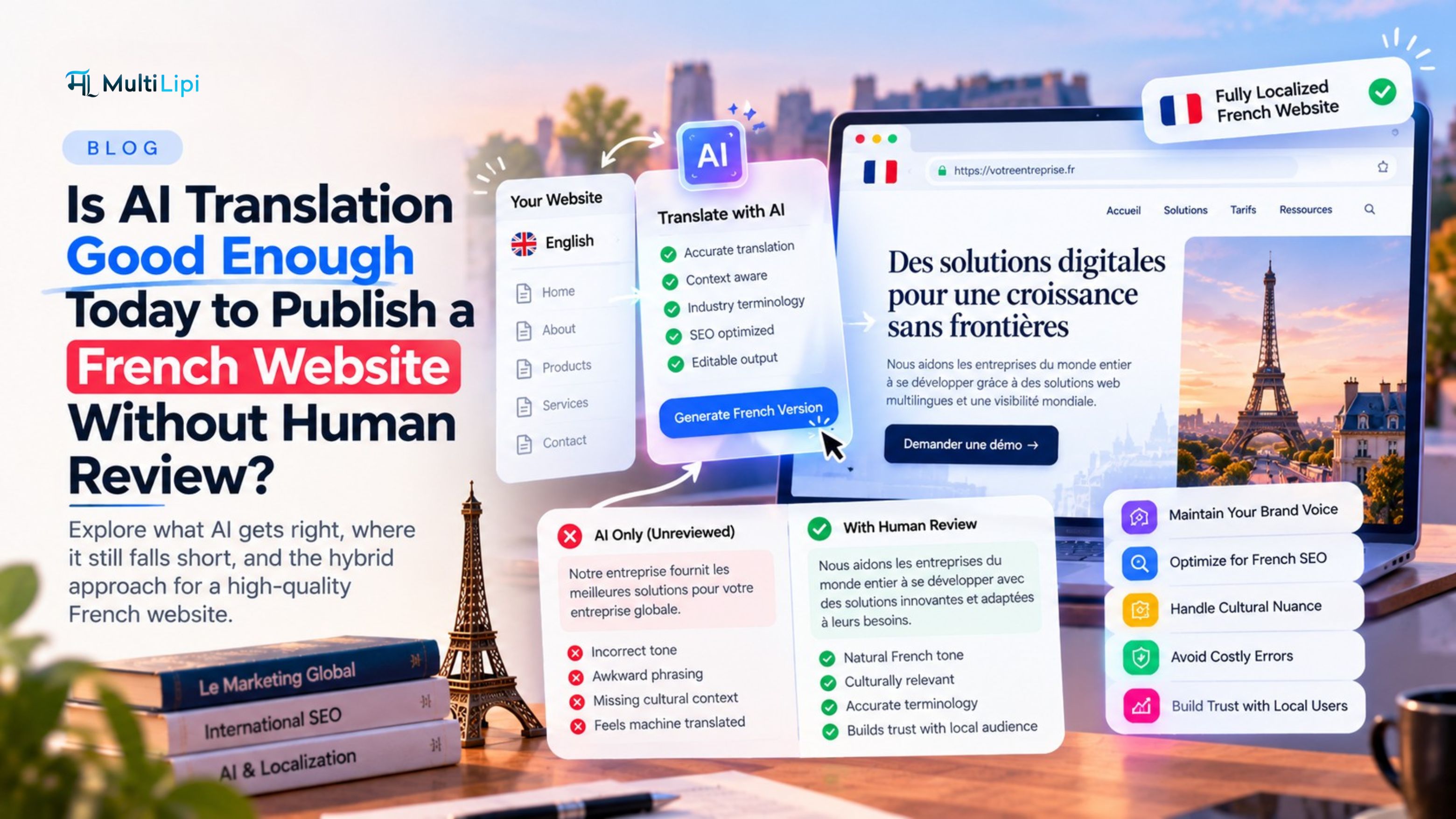
Almost. AI translation has improved sharply, and for many pages the first French draft is now strong, arriving in minutes at a fraction of the price of a human translator. But "almost" is where brand voice, accuracy and trust are won or lost, and the cost and turnaround gap between AI and human French website translation narrows once you add the review time that quality demands. A fully human translation takes days and costs several times more, while AI with targeted human editing often delivers near-human quality at a much lower price and faster pace, so the real question is how much review you need and where.
How far AI translation has come
AI translation is good, and you should say so plainly. Automated translation has come a long way since the early days of Google Translate.
Tools like DeepL and ChatGPT now handle "information-only" French with real accuracy, and their error rates on straightforward content keep falling. Mistakes still surface, though: idioms get translated literally, formal and informal address (vous versus tu) drift, and gendered agreements or false friends like "actuellement" slip through unnoticed. For small projects, AI is fast, cheap, and increasingly capable, as long as someone who reads French checks the output before it goes live.
Why publishing unreviewed French is still a gamble
But accurate is not the same as publishable. The errors machines make are also different from human ones.
For a public French website, slips like these cost you trust. At MultiLipi, we see the safer path as an AI draft with editable translations and a human review before anything goes live.
How Far Machine Translation Has Come
The AI and machine translation boom has put tools like Google Translate, DeepL and ChatGPT within reach of every website owner. They are fast, cheap and easy to use, and they save real time and translation cost compared with traditional translation agencies.
AI/MT (artificial intelligence/machine translation) uses neural models to convert text between languages in seconds. For French, it delivers strong first drafts at scale, but tone, register and cultural fit still need a human eye.
For information-only translation, the quality is now high. Machine translation handles factual information well, such as product specifications, help articles and straightforward descriptions. Add a human reviewer and it becomes a very valid option.
The reviewer matters because fluent output can still hide errors. Brand names, idioms, tone and industry terms are where raw machine output tends to slip.
A workflow with editable translations lets you fix those lines once and keep them. A platform like MultiLipi supports this, so your corrections stay consistent across every page and language.
Where AI Translation Still Fails
Translation errors tend to appear in the details. One machine translation engine rendered the Swiss town of Aubonne as "Augood." A slip like that on a French page tells visitors nobody checked it.
AI understands very little about nuance, subtlety and humor. It handles word-for-word equivalents quickly but stumbles when the writing needs care, and that hurts accuracy exactly where your brand is most visible.
There is also a recognizable AI writing style. Most professional translators can spot machine output after the first two sentences, because each engine has its own habits. If translators can spot it, your French customers often can too.
Best when brand voice and audience expect familiarity
Often appropriate for professional or respectful address
Marketing Copy Needs Human Word Choice
Persuasion depends on word choice. A tool like DeepL will not spend half an hour comparing three possible headlines or weighing "profits rose significantly" against "profits skyrocketed."
A specialized human translator does exactly that. When you need to move an audience or win a sale, human judgment is the better investment.
Cultural Fit and Knowledge of the Target Market
Translation is not only about language. A private French university had not thought about services for the parents of international students, such as welcome events, family weekends and a Facebook group for parents. American parents commonly expect all of these.
The author's conclusion was blunt: AI does not know that. It can translate the words, but it misses how formal a French reader expects a brand to sound, which jokes feel out of place, and how much warmth or restraint builds trust. A human translator who understands the target market catches these gaps by localizing tone, nuance, and cultural expectations for French audiences, and that matters for pages aimed at visitors in France.
Why Human Review Still Protects You
Machine translation with a human reviewer can be an excellent way to convey facts. Quality has improved sharply, and for informational content the hybrid approach is often enough. An editable translation lets a reviewer fix tone, terminology and brand voice before anything goes live.
When reputation or legal risk is at stake, you need a specialized human translator, with legal review where appropriate. Contracts, compliance pages and legal documents belong in that category. A small wording error in a liability clause can change its meaning entirely.
Data privacy deserves a check too. Uploading contracts, medical records, or internal reports to an AI translation tool means your content travels to the provider's servers, subject to the provider’s specific retention, access, and training policies. That creates real confidentiality risks, and not every tool is appropriate for every document. Read the provider's data retention and training policies, then match the tool to the sensitivity of the content, keeping highly confidential material for secure or offline options.
A platform like MultiLipi, which keeps translations editable, lets you review sensitive pages before publishing.
The Hybrid Workflow That Works
The smartest approach combines both strengths:
- Use AI translation for speed, coverage and a solid first draft.
- Keep translations editable so reviewers can fix terminology, tone and errors directly.
- Send high-visibility pages, such as the homepage, product pages and campaigns, to a human reviewer first.
- Save professional translators for legal, regulated and reputation-sensitive content.
This is where a platform like MultiLipi fits. It pairs AI-enabled localization with editable translations, so your team can refine the French copy without rebuilding anything.
What This Means for Multilingual SEO and Generative Engines
Search engines and generative engines both favor content that reads naturally and stays consistent across languages. Awkward phrasing, wrong names and mismatched terminology weaken your credibility with both readers and algorithms.
Machine translation still drifts. A product name may be translated in one place and left alone in another. A key term may shift between near synonyms from page to page. Those small inconsistencies make it harder for crawlers and AI systems to treat your pages as one reliable source.
A reviewed French site gives you cleaner, more trustworthy pages for multilingual SEO. It also gives generative engines clearer, more accurate content to draw on when answering questions in French.
With a platform like MultiLipi, your reviewer can correct a term once and keep it consistent across the site, so brand voice holds as you scale.
What Modern AI Translation Does Well in French
Neural engines and large language models compared
When comparing DeepL, Google Translate and ChatGPT for French accuracy on a website, the first distinction is purpose. Neural machine translation engines such as DeepL and Google Translate are built for translation, which makes them consistent at handling large volumes of page content, menus, and product listings, and their French output tends to stay stable in grammar, terminology, and formatting. General chatbots such as ChatGPT translate as one of many tasks, so they can adjust tone and context for a French audience, including formal or informal address, but their accuracy may vary more from one page to the next.
- Neural engines: fast, consistent, predictable.
- Chatbots: flexible, and can adjust tone.
Both produce fluent French. Smooth output can still hide a wrong term or a mistranslated name unless someone checks.
Content types where raw output holds up
For internal use, bulk content, and subtitles, DeepL, Google's neural engine, and GPT-4o are fast and cheap.
Raw output fits:
- Internal documents.
- Low-risk reference content.
- First drafts a reviewer will refine.
Your public French website is different. Visitors read it as your voice.
Neural MT
Speed at scaleA reliable first draft for repetitive and factual information.
General AI assistants
Flexible adaptationCan follow prompts for register and style, but needs consistency checks.
Human reviewer
Editorial judgmentChecks terminology, cultural fit, brand nuance, and high-risk meaning.
Where AI French Still Falls Short
Speed does not guarantee accuracy. French exposes a few weak spots again and again.
Register, formal and informal address, and tone
French forces a choice between formal and informal register: "tu" or "vous." In AI translation, that choice is easy to get wrong. A model may address a customer as "tu" when "vous" was expected, or slide between the two on the same page, which makes a brand sound careless or oddly familiar. Without clear instructions on audience and tone, the AI is only guessing at the register.
- A luxury brand that says "tu" sounds careless.
- A youth brand that says "vous" sounds stiff.
Idioms, humor, and cultural nuance
Humor and subtlety are where machines struggle most. A joke gets flattened, and a slogan turns literal.
The French is often correct on paper and lifeless on screen.
Names, terminology, and gendered agreement errors
French also expects adjectives and participles to agree with noun gender. A person with French expertise needs to read the result before it goes live.
Expert Insight
"La traduction automatique égale presque l'humain en grammaire et en fidélité sémantique de base, mais elle échoue sur les expressions idiomatiques, le ton et le sous-texte culturel. Les erreurs de l'IA ne sont pas celles d'un traducteur humain : c'est pourquoi un expert du français doit relire le résultat avant sa mise en ligne." , Analyste spécialisé en traduction et communication interculturelle
What Unreviewed Translation Risks for Brand and Trust
Legal, compliance, and product accuracy issues
Publishing without review turns every small error into a public statement from your company, and in French that statement can carry legal weight. A mistranslated warranty, disclaimer, or safety notice can breach consumer protection rules, and France's Toubon Law requires French-language versions of key commercial and product information. An unreviewed privacy policy or contract clause can also leave you out of step with GDPR obligations or open to disputes over what you actually promised. Whichever tool you use, a real person who knows both the language and the regulations must check the result.
Terms of sale, privacy notices, safety information, and product specifications must say exactly what you mean. For French audiences, they must also meet French legal requirements: the Toubon Law requires consumer-facing contracts, instructions, and warranties to be available in French, and GDPR notices must be clear and understandable to the people they address. A rough translation can leave a site out of compliance. When legal risk is at stake, use a specialized human translator.
- Terms and conditions: a wrong term can change what a customer agreed to.
- Product pages: a mistranslated measurement creates false expectations.
How French-speaking visitors read awkward text
Visitors form an impression fast, and awkward French signals that nobody checked it. They may not name the problem. They simply trust you less.
Review is the inexpensive safeguard. It costs far less than the credibility you lose.
Expert Insight
"The AI translation tools can deliver speed, but they do not weigh nuance, persuasion, or local market expectations. Readers who notice errors begin to doubt your prices and claims, and trust is slow to build and quick to lose. A human review of the page is the inexpensive safeguard." , Professional Translation Specialist
Multilingual SEO Realities for French Pages
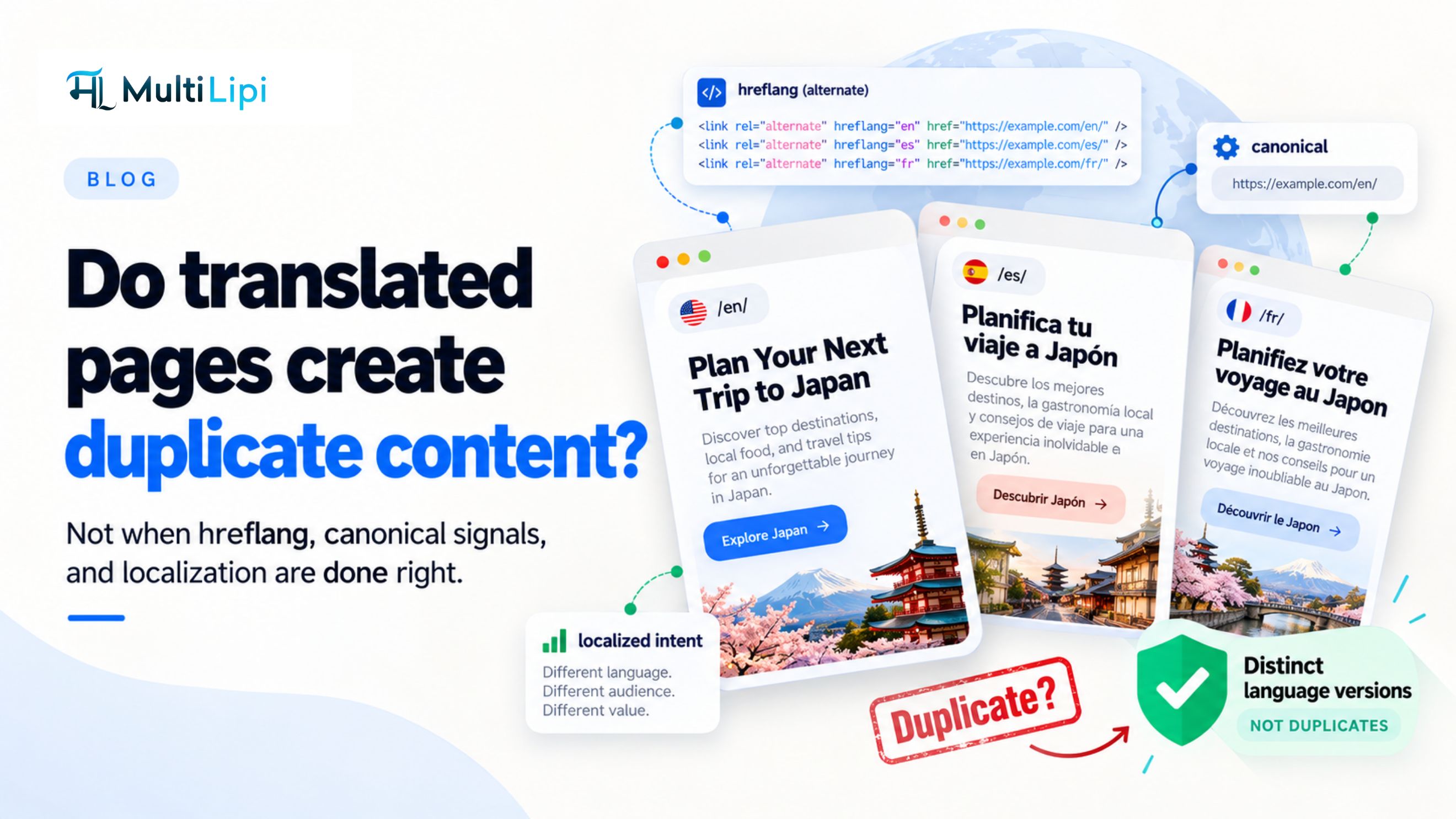
A translated page is not an optimized page. The SEO impact of AI-translated French pages depends on decisions raw machine translation does not make: a deliberate URL structure for French site versions, whether subdirectories like /fr/, subdomains, or country-code domains, paired with correct hreflang tags that tie each French version to its source and to regional variants such as fr-FR, fr-CA, or fr-BE; French keyword research that reflects how people actually search rather than how English terms translate; and clean indexing signals that keep search engines from treating the page as thin or duplicate content. Hreflang annotations must be reciprocal, self-referencing, and consistent with canonical tags and the chosen URL pattern, because mismatches lead search engines to ignore them and serve the wrong language version. Without these foundations, French search visibility stays out of reach.
Keyword research in French rather than literal translation
French keyword research is not the same as literal keyword translation: French searchers do not always use the direct equivalent of your English keyword, so translating terms word for word often targets phrases nobody actually types. Real search behavior also shifts between France and other French-speaking markets such as Belgium, Switzerland, and Canada, where vocabulary, spelling, and phrasing differ. Regional French variants matter for website localization because a single French site rarely fits every audience: Belgians and Swiss users say septante and nonante where French users say soixante-dix and quatre-vingt-dix, Canadians often favor terms like courriel over e-mail and magasiner over faire les courses, and each market has its own conventions for currency, dates, and formal address. Building separate or at least adapted pages for France, Canada, Belgium, and Switzerland, each with the right hreflang tags such as fr-FR, fr-CA, fr-BE, and fr-CH, helps search engines serve the correct version and helps visitors feel the content was written for them. Starting from native search data rather than a translated keyword list shows which terms your audience really uses in each market.
- Research each target term in French with a local keyword tool.
- Feed approved terms back into your glossary.
Hreflang, URL structure, and metadata
- hreflang tags link each English page to its French counterpart, and back.
- A clear URL structure keeps versions separate.
- Title tags, meta descriptions, alt text, and headings need reviewed French.
Search engine stance on automated translation and quality
Check each engine's current guidance on automated translation.
Generative answer engines summarize content they can read clearly, so inconsistent terminology makes your pages harder to quote accurately.
Treat automated translation as a draft, then have a human translator confirm keywords, tone, and metadata.
A Hybrid Workflow That Protects Quality
The right answer is AI plus a human reviewer.
AI first draft with editable translations
For French website content, a professional translator may handle a few thousand words in a workday depending on subject and complexity, and the bill climbs with every page. AI produces a full draft in moments at a fraction of the price. Human translation costs more and takes days on a large site, but the gap in turnaround and cost is what makes AI the first pass for most French web projects.
Keep every line editable so a reviewer can fix a phrase directly, especially during human review and post-editing of AI-translated French pages, where a native speaker can correct tone, gender agreement, and formal or informal address before anything goes live. That editing layer works best when it sits inside your website integration: a translation plugin that connects to your CMS can pull new content into a French version automatically, route it to a reviewer inside the existing publishing workflow, and hold the page as a draft until approval. Tools like MultiLipi offer this editing layer alongside plugin and CMS connections, so corrections made to the French text stay in sync with the live site.
Targeted human review where it matters most
Match review effort to risk. Set risk-based human review levels for translated French pages: give legal, medical, and checkout content a full native-speaker edit, apply a careful editorial review to high-visibility marketing copy, and give lower-risk informational pages a lighter review supported by automated quality checks.
- Full review: legal terms, privacy notices, pricing, and checkout pages.
- Careful review: home page, titles, meta descriptions, and calls to action.
- Light check: information-only content.
Glossaries, translation memory, and brand voice rules
Build a glossary of approved French terms and pair it with a translation memory of approved sentences, so every product name, feature label, and recurring phrase stays consistent across all French content. Add brand voice rules to guide tone, formality, and style.
Each correction improves the next draft.
Legal, medical, safety, privacy, pricing and checkout
Homepage, campaign copy, titles and calls to action
Low-risk informational pages and internal material
The Bottom Line
You can publish AI translation quickly, but publishing it unreviewed can put your brand at risk. Let AI do the heavy lifting, and let people protect accuracy, voice and trust.
Fluent does not mean correct. Errors now hide behind smooth wording. A product claim can shift in meaning, a legal term can lose precision, or a tone built for one market can sound cold in another.
Readers rarely notice the mistake, but they feel it.
A hybrid workflow closes that gap. Machine output gives you speed, and an editable translation layer lets reviewers fix wording, terminology and tone without starting over.
Pages that read as natural, accurate local content are easier for users to trust and for search engines to interpret; this does not guarantee generative-engine citations. A platform like MultiLipi lets you edit translations and apply review before pages go live.
FAQ
How good is AI translation now?
It is clearly good. Acceptance rates vary widely by model, content type, evaluation criteria, and human review process; published headline percentages are not a substitute for testing your own French content.
The question is whether it is good enough to remove the human reviewer.
What is the most accurate translator for French?
No single tool wins on every text. DeepL, Google Translate, and ChatGPT all produce usable French drafts.
Accuracy depends on the content, the terminology, and whether a human translator checks the result.
Are French translators in demand?
Yes, though the work is shifting. Translators report changing demand and workflows as AI becomes more widely used, but the impact varies by specialty and market.
Even so, a real person still has to review the output, and the errors machines make differ from those a human makes.
What are the downsides of AI translation?
- Awkward tone and wrong register that French readers notice quickly.
- Terminology that shifts from page to page without a glossary.
- Data privacy exposure when you paste confidential documents into public tools.
- Fluent sentences that hide mistakes in meaning.
When is raw AI output acceptable?
For internal use, bulk content, and subtitles, AI translation is fast and cheap enough to use as is. For small projects, it is often the sensible choice.
A public French website is different. It represents your brand, so a human review step is the safer path.
Can I keep AI speed and still protect quality?
Yes. Use AI for the first draft, keep the translations editable, and send high-risk pages to a reviewer.
A glossary and translation memory carry each correction forward, so your time savings compound with every page you publish.
"Companies really should have a fluent professional look over their content before publishing. Thoughtful, accurate communication matters, and relying solely on AI only creates misunderstandings and leaves the wrong impression." , Anne H., French translator
Conclusion
AI translation is good, and for French it now produces drafts that would have seemed out of reach a few years ago. But for a public website, it is still not good enough to replace the human reviewer.
The gap is not speed or cost. It is trust. Your French pages speak for your brand, and a human reviewer catches what fluent output can hide, from translation errors to a flat writing style.
The practical path is a hybrid one:
- Let AI produce the first draft.
- Keep every line editable so fixes are fast.
- Send high-risk pages to a human translator.
- Build a glossary and translation memory so quality compounds.
At MultiLipi, we see this as the balance that works: machine speed with human judgment where it counts. Publish fast, but never unchecked.
Continue Learning with MultiLipi
Explore these related multilingual SEO, translation editing, and quality-control resources.
- AI translation and human review
- Translation memory in MultiLipi
- Glossary rules for consistent terminology
- Translation memory vs glossary
- Website translation vs localization
- Guide to multilingual SEO
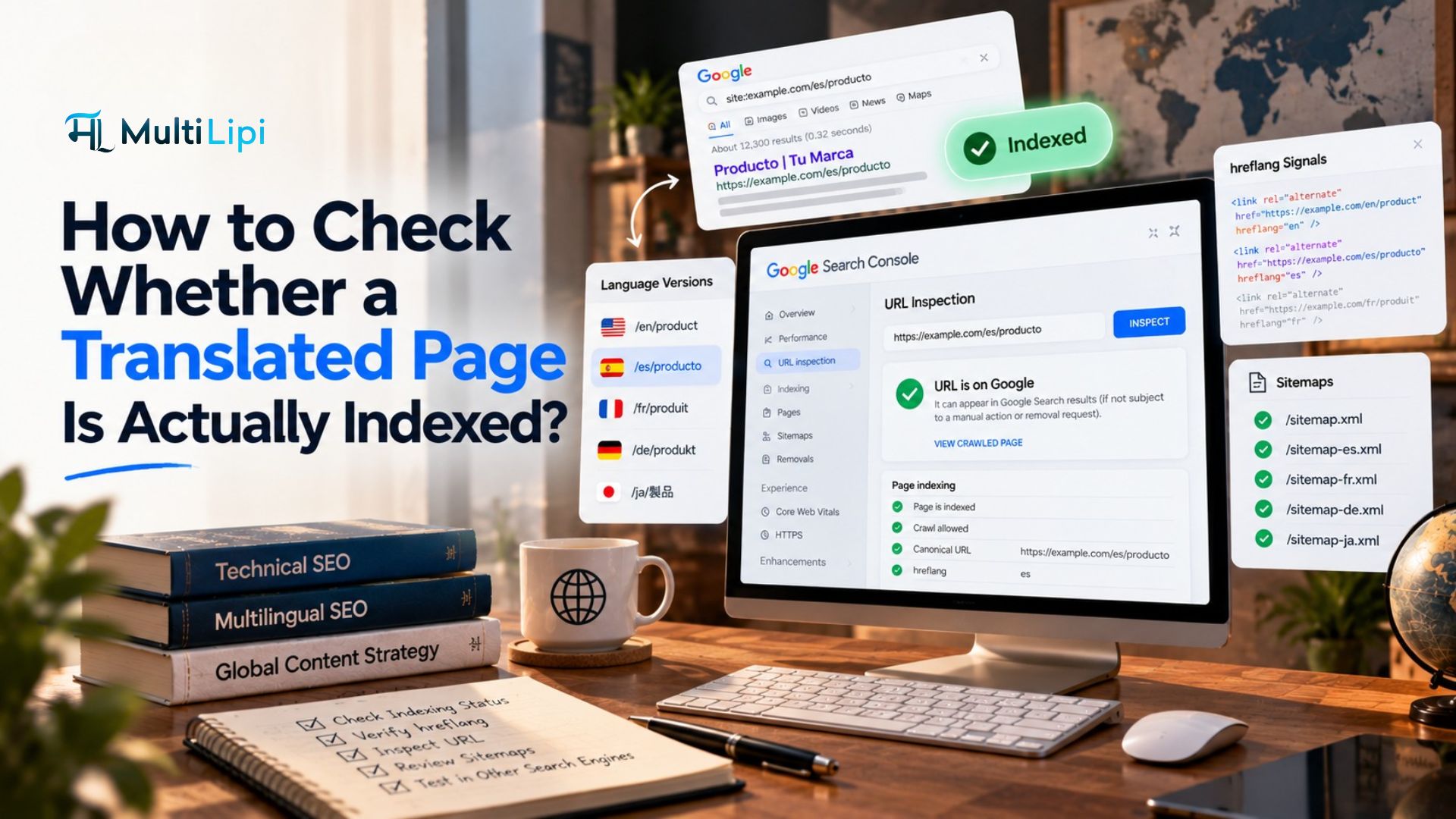
- Check French hreflang implementation
- Multilingual SEO and generative AI
- Translation workflow guide
- Visual translations editor